
Source-grounded drafting
Prepare selected CSR sections using the approved documents and report template.
AI-Assisted Clinical Reporting
We are developing an AI-assisted workflow to help medical writers turn approved study documents into structured report drafts, with source checks and expert review at every important step.
The idea, in plain terms
A Clinical Study Report, or CSR, brings together how a study was conducted, what was measured, what the results show and what conclusions can reasonably be drawn.
Writers must reconcile protocols, study records, bioanalytical reports, statistical outputs and established templates. Repeated manual assembly and cross-checking can make this work demanding.
Our initial focus is a reporting assistant for bioequivalence studies: helping writers assemble selected sections and check them against the approved sources.
From evidence to an editable draft
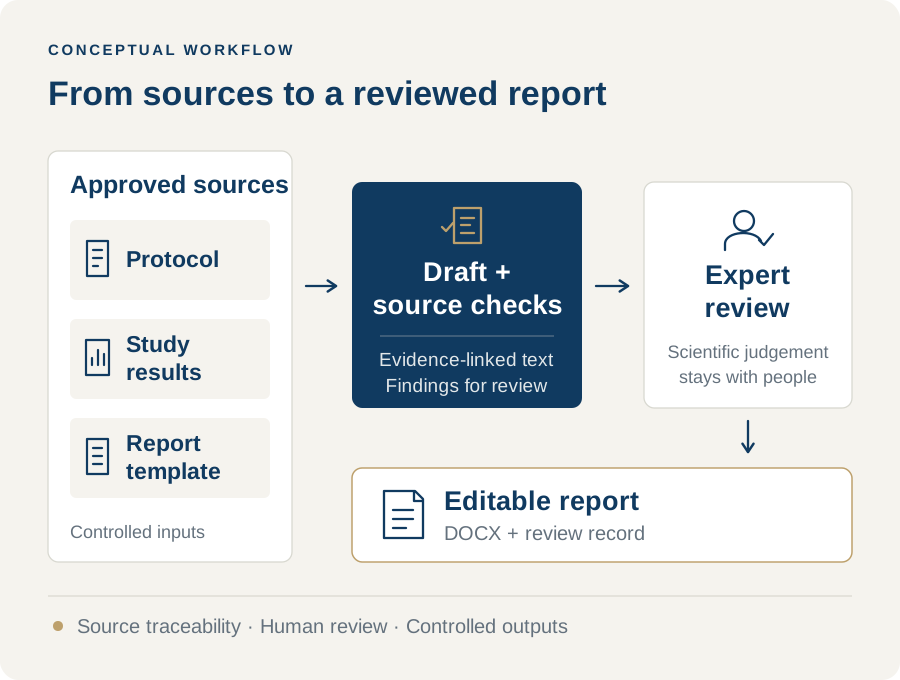
The proposed workflow combines source-grounded drafting with explicit checks and reviewer control.
Select the study documents, reporting template and applicable requirements.
Identify study descriptors, source tables, key values and document references.
Prepare repeatable report content from source evidence and the chosen template.
Highlight missing information, inconsistent values and unsupported statements.
Let designated experts resolve findings and export an editable Word draft with a findings log.
Planned capabilities
A focused first product for a defined report workflow, with expansion guided by practical experience.
Prepare selected CSR sections using the approved documents and report template.
Compare selected narrative values with approved PK or statistical outputs, and flag mismatches for review.
Compare study dates, subject counts, treatment names and other defined study facts across sources.
Highlight missing sections, references or information against the selected template and documented rules.
Link generated content and findings to relevant documents, pages or tables where feasible.
Provide a Word draft, findings log and review record that fit an expert-led writing process.
Technical, without the complexity
Fluent text is only one part of a dependable reporting workflow.
The proposed approach uses source-grounded AI for suitable drafting tasks, alongside defined checks for selected facts, numbers and report structure. Findings would remain visible for a qualified reviewer to resolve.
Scientific interpretation, statistical assessment and final approval remain with the responsible experts.
Use relevant source content and a controlled template to prepare selected narrative sections.
Compare defined values and study facts; record inconsistencies with supporting references.
Medical writers, statisticians, clinical reviewers and QA retain their responsibilities.

A focused starting point
Bioequivalence (BE) studies generally compare how a test and reference product deliver an active ingredient into the body. Their reports draw together study conduct, pharmacokinetic results, statistical outputs and safety information.
The initial concept focuses on selected sections of a BE CSR and a small number of controlled templates. ICH E3 provides a recognised framework for CSR structure and content.
A longer-term direction is broader clinical and regulatory document consistency. The Common Technical Document (CTD) is a structured dossier format; expansion into wider dossier assurance would be a later, separately evaluated stage.
Read about ICH E3Our development collaboration
Developed in collaboration with our specialist AI technology partner, Mr Shabaz, an AI engineer from IIT Kharagpur.
Both initiatives are in concept and initial development. We are shaping their scope around practical scientific workflows and welcome conversations with interested teams.
A few useful answers